
11. Mar 2026.
Blank Labels in Industrial Marking: How to Choose the Right Solution for Reliable Product Identification
.png)
In modern production and logistics systems, product identification represents a key element of quality control, traceability, and efficient goods management. Barcodes, product declarations, and logistics labels enable automated tracking of products throughout different stages of production, storage, and distribution.
At the core of these systems are blank labels—self-adhesive labels without pre-printed content, intended for the subsequent printing of information such as barcodes, serial numbers, declarations, or logistics markings.
Although they are often perceived as a simple consumable, the choice of blank labels has a direct impact on the stability of the labeling system and the reliability of product identification.

Blank Label Printing Technologies
In industrial and logistics applications, blank labels are most commonly used with two printing technologies: direct thermal and thermal transfer.
Direct Thermal Printing
In direct thermal printing, the image is created by directly heating the thermal layer of the label. This technology does not require the use of a ribbon (thermal transfer ribbon), which simplifies the printing system and reduces consumable costs.
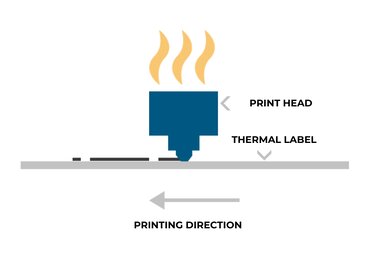
Direct thermal labels are typically used for applications where the durability of the marking is limited, such as:
- retail scale labels
- fruit and vegetable labels
- shipping labels
- short-term logistics labels
- event tickets
Materials used in this technology include Thermal ECO and Thermal TOP labels.
Thermal TOP materials include an additional protective layer that provides greater resistance of the print to external influences.
Thermal Transfer Printing
In thermal transfer printing, the image is produced using a ribbon that transfers ink onto the label surface under heat.
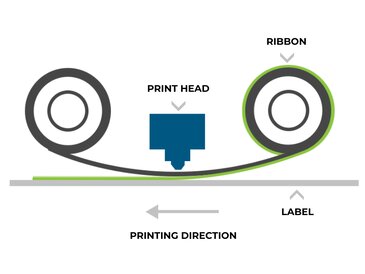
This technology provides:
- higher print durability
- resistance to mechanical abrasion
- more stable barcode readability
- improved resistance to moisture and environmental conditions
For this reason, thermal transfer labels are widely used in logistics, warehouses, and industrial applications such as:
- product labeling
- transport packaging identification
- inventory management systems
- asset and equipment labeling
Blank Label Materials
The label material is one of the key factors affecting label durability and resistance to external influences.
In industrial applications, paper and synthetic materials are most commonly used.
Paper Labels
Paper labels, such as vellum matte or vellum semi-gloss materials, represent an economical and widely used solution for logistics and product declarations.
Their main characteristics include:
- good print readability
- cost-effective performance
- wide application in warehouses and distribution systems
Synthetic Materials
For more demanding application conditions, synthetic materials are used, offering greater resistance to:
- moisture
- mechanical abrasion
- chemicals
- temperature changes
These labels are used in industrial applications where the label must remain readable over a longer period or under demanding environmental conditions.
Adhesive System
In addition to the label material, the adhesive system—the type of adhesive used to bond the label to the surface—also plays a crucial role.
The adhesive selection must be aligned with:
- the material of the surface to which the label is applied
- application temperature
- storage and transport conditions
- the expected lifetime of the label
Key technical parameters that determine adhesive performance include:
- initial tack
- peel adhesion
- application temperature range
An inadequate adhesive selection can result in gradual label detachment during product transport or storage.
Environmental Conditions
When selecting blank labels, it is also necessary to consider the conditions in which the label will be used. Factors such as temperature, humidity, friction during transport, or exposure to chemicals can significantly affect label durability and print readability.
In logistics systems, it is particularly important that the label remains readable throughout the entire product lifecycle—from production and storage to transportation and final delivery to the end customer.
Blank labels represent an important component of industrial marking systems and logistics product identification. Their selection should not be considered solely in terms of price or label dimensions, but rather as part of a broader system that includes printing technology, label material, adhesive system, and application conditions.
A properly selected label ensures stable product identification, reliable barcode readability, and efficient operation of logistics processes.
At Elmed, we develop and supply blank labels tailored to various industrial and logistics applications, while also providing support in selecting the optimal solution for each labeling system.